2021年10月14日 星期四

[LeetCode] 85. Maximal Rectangle

轉自LeetCode

Given a rows x cols binary matrix filled with 0's and 1's, find the largest rectangle containing only 1's and return its area.


Example 1:

Input: matrix = [["1","0","1","0","0"],["1","0","1","1","1"],["1","1","1","1","1"],["1","0","0","1","0"]]
Output: 6
Explanation: The maximal rectangle is shown in the above picture.

Example 2:

Input: matrix = []
Output: 0

Example 3:

Input: matrix = [["0"]]
Output: 0

Example 4:

Input: matrix = [["1"]]
Output: 1

Example 5:

Input: matrix = [["0","0"]]
Output: 0


Constraints:

  • rows == matrix.length
  • cols == matrix[i].length
  • 0 <= row, cols <= 200
  • matrix[i][j] is '0' or '1'.

Solution

[LeetCode] 84. Largest Rectangle in Histogram

轉自LeetCode

Given an array of integers heights representing the histogram's bar height where the width of each bar is 1, return the area of the largest rectangle in the histogram.


Example 1:

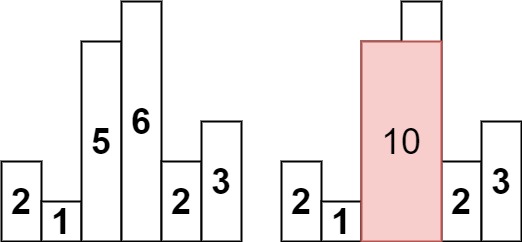
Input: heights = [2,1,5,6,2,3]
Output: 10
Explanation: The above is a histogram where width of each bar is 1.
The largest rectangle is shown in the red area, which has an area = 10 units.

Example 2:

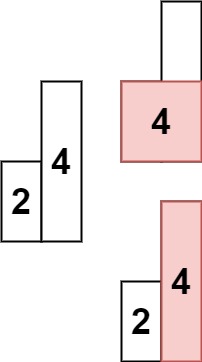
Input: heights = [2,4]
Output: 4


Constraints:

  • 1 <= heights.length <= 105
  • 0 <= heights[i] <= 104

Solution

2021年10月13日 星期三

[LeetCode] 1092. Shortest Common Supersequence

轉自LeetCode

Given two strings str1 and str2, return the shortest string that has both str1 and str2 as subsequences. If there are multiple valid strings, return any of them.

A string s is a subsequence of string t if deleting some number of characters from t (possibly 0) results in the string s.


Example 1:

Input: str1 = "abac", str2 = "cab"
Output: "cabac"
Explanation: 
str1 = "abac" is a subsequence of "cabac" because we can delete the first "c".
str2 = "cab" is a subsequence of "cabac" because we can delete the last "ac".
The answer provided is the shortest such string that satisfies these properties.

Example 2:

Input: str1 = "aaaaaaaa", str2 = "aaaaaaaa"
Output: "aaaaaaaa"


Constraints:

  • 1 <= str1.length, str2.length <= 1000
  • str1 and str2 consist of lowercase English letters.

Solution

[LeetCode] 712. Minimum ASCII Delete Sum for Two Strings

轉自LeetCode

Given two strings s1 and s2, return the lowest ASCII sum of deleted characters to make two strings equal.


Example 1:

Input: s1 = "sea", s2 = "eat"
Output: 231
Explanation: Deleting "s" from "sea" adds the ASCII value of "s" (115) to the sum.
Deleting "t" from "eat" adds 116 to the sum.
At the end, both strings are equal, and 115 + 116 = 231 is the minimum sum possible to achieve this.

Example 2:

Input: s1 = "delete", s2 = "leet"
Output: 403
Explanation: Deleting "dee" from "delete" to turn the string into "let",
adds 100[d] + 101[e] + 101[e] to the sum.
Deleting "e" from "leet" adds 101[e] to the sum.
At the end, both strings are equal to "let", and the answer is 100+101+101+101 = 403.
If instead we turned both strings into "lee" or "eet", we would get answers of 433 or 417, which are higher.


Constraints:

  • 1 <= s1.length, s2.length <= 1000
  • s1 and s2 consist of lowercase English letters.

Solution

[LeetCode] 1137. N-th Tribonacci Number

 轉自LeetCode

The Tribonacci sequence Tn is defined as follows: 

T0 = 0, T1 = 1, T2 = 1, and Tn+3 = Tn + Tn+1 + Tn+2 for n >= 0.

Given n, return the value of Tn.


Example 1:

Input: n = 4
Output: 4
Explanation:
T_3 = 0 + 1 + 1 = 2
T_4 = 1 + 1 + 2 = 4

Example 2:

Input: n = 25
Output: 1389537


Constraints:

  • 0 <= n <= 37
  • The answer is guaranteed to fit within a 32-bit integer, ie. answer <= 2^31 - 1.

Solution

2021年10月12日 星期二

[LeetCode] 174. Dungeon Game

轉自LeetCode

The demons had captured the princess and imprisoned her in the bottom-right corner of a dungeon. The dungeon consists of m x n rooms laid out in a 2D grid. Our valiant knight was initially positioned in the top-left room and must fight his way through dungeon to rescue the princess.

The knight has an initial health point represented by a positive integer. If at any point his health point drops to 0 or below, he dies immediately.

Some of the rooms are guarded by demons (represented by negative integers), so the knight loses health upon entering these rooms; other rooms are either empty (represented as 0) or contain magic orbs that increase the knight's health (represented by positive integers).

To reach the princess as quickly as possible, the knight decides to move only rightward or downward in each step.

Return the knight's minimum initial health so that he can rescue the princess.

Note that any room can contain threats or power-ups, even the first room the knight enters and the bottom-right room where the princess is imprisoned.


Example 1:

Input: dungeon = [[-2,-3,3],[-5,-10,1],[10,30,-5]]
Output: 7
Explanation: The initial health of the knight must be at least 7 if he follows the optimal path: RIGHT-> RIGHT -> DOWN -> DOWN.

Example 2:

Input: dungeon = [[0]]
Output: 1


Constraints:

  • m == dungeon.length
  • n == dungeon[i].length
  • 1 <= m, n <= 200
  • -1000 <= dungeon[i][j] <= 1000

Solution

[LeetCode] 763. Partition Labels

轉自LeetCode

You are given a string s. We want to partition the string into as many parts as possible so that each letter appears in at most one part.

Return a list of integers representing the size of these parts.


Example 1:

Input: s = "ababcbacadefegdehijhklij"
Output: [9,7,8]
Explanation:
The partition is "ababcbaca", "defegde", "hijhklij".
This is a partition so that each letter appears in at most one part.
A partition like "ababcbacadefegde", "hijhklij" is incorrect, because it splits s into less parts.

Example 2:

Input: s = "eccbbbbdec"
Output: [10]


Constraints:

  • 1 <= s.length <= 500
  • s consists of lowercase English letters.

Solution